
 By admin
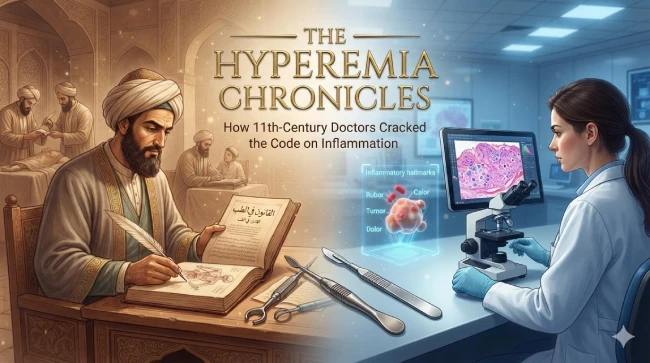
Long before microscopes or cellular staining, 11th-century physicians were already mapping out the vascular mechanics of human immunity. While medieval Europe looked at acute inflammation as a spiritual curse, Islamic Golden Age pioneers like Ibn Sina and Al-Zahrawi treated it as a dynamic, defensive biological battlefield. From categorizing fluid exudates to inventing specialized tools like the olivary cautery to control capillary leakage, their work directly mirrors modern pathology blocks.
Ancient Bio-Defenses: How 11th-Century Doctors Cracked the Code on Inflammation
Summary
- The Paradigm Shift: Medieval Islamic physicians stopped viewing acute inflammation as an evil omen and reclassified it as a dynamic cellular battlefield.
- The Discovery: Ibn Sina categorized distinct types of inflammatory swelling (Aram), linking them directly to vascular changes and specific bodily fluids.
- The Surgical Legacy: Al-Zahrawi engineered specialized surgical instruments to mechanically modulate the body’s inflammatory response.
- Modern Resonance: Their ancient descriptive work mirrors the exact classic hallmarks of inflammation—heat, redness, pain, and swelling—taught in pathology blocks today.
Keywords: Islamic Golden Age medicine, history of pathology, Ibn Sina Canon of Medicine, Al Zahrawi surgical instruments, history of inflammation, medieval surgery, ancient immunology, acute inflammation hallmarks
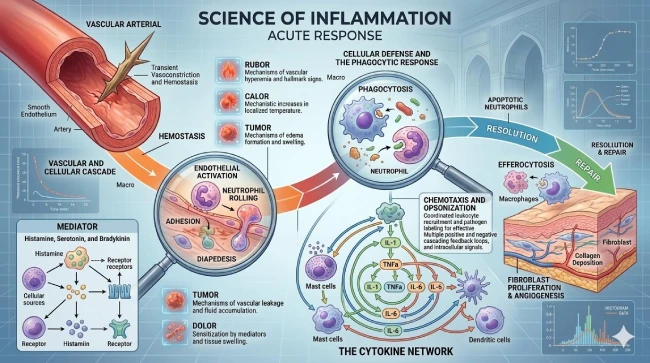
Every medical student remembers their first pathology lecture on acute inflammation. You learn the classic Latin hallmarks: Rubor (redness), Calor (heat), Tumor (swelling), and Dolor (pain).
But while European medicine during the Middle Ages was frequently attributing these symptoms to bad spirits or spiritual imbalances, Islamic Golden Age polymaths were treating inflammation like an advanced biological defense network. They were among the first to decouple acute inflammation from permanent disease, framing it instead as a dynamic, defensive physiological response. By mapping out the precise vascular and cellular changes of inflammation 1,000 years ago, they laid out the groundwork for modern immunology and pathology.
Ibn Sina’s Inflammatory Taxonomy: Breaking Down “Aram”
In the Canon of Medicine (Al-Qanun fi al-Tibb), Ibn Sina (Avicenna) dedicated extensive chapters to the study of inflammatory swellings, which he termed Aram. Instead of viewing all swelling as a single, static disease, he realized it was a localized reaction to an underlying physiological insult.
He brilliantly categorized inflammatory conditions based on what modern pathologists would call exudate composition and vascular permeability. In his notes on Hot Inflammatory Swellings (Aram al-Harrah), he observed tissues that quickly became hot, bright red, and intensely painful. He correctly deduced that this was caused by an active influx of blood rushing to the site of injury—the exact mechanism modern medicine terms active hyperemia.
The Fluid Dynamics: Blood, Bile, and Phlegm
Ibn Sina did not stop at blood. He mapped inflammation across a spectrum of systemic responses, predicting the diverse types of exudates we classify today:
Sanguineous (Dem): Driven by pure blood, resulting in classic acute, bright red swelling.
Bilious (Safra): Associated with yellow bile, presenting sharp, burning, and spreading inflammation (akin to modern erysipelas).
Phlegmatic (Balgham): A slow, cold, boggy swelling, mirroring chronic edematous or mucoid fluid accumulation.
Melancholic (Sawda): Hard, indurated, and non-yielding masses, correlating closely with modern descriptions of fibrotic tissue or chronic granulomas.
By treating these fluids as active physiological agents rather than static humors, Islamic physicians recognized that the body actively alters its localized environment to isolate threats.
Operationalizing the Defense: Surgical Interventions for Aram
Understanding inflammation was only half the battle; Islamic Golden Age surgeons developed precise physical interventions to modulate this dynamic biological warfare. If inflammation was the body’s over-active opening salvo, surgery was the tactical strike used to guide, accelerate, or halt it.
Controlled Decongestion: Venesection and Cupping
To manage Aram al-Harrah (hot inflammatory swellings), physicians like Al-Zahrawi (Abulcasis) utilized targeted bloodletting (Fasd). This was not a random draining of life force, but a highly localized decompression tactic:
The Logic: Relieve the intense vascular pressure (rubor and calor) at the injury site.
The Method: Diverting the “rushing torrent” of blood away from vital organs toward peripheral sites.
Wet Cupping (Hijama): Used to draw localized stagnant fluids and inflammatory mediators directly from the tissue.
The Ultimate Containment: Cauterization (Kayy)
When an inflammatory swelling threatened to spread or turn gangrenous, surgeons turned to the definitive firewall: cauterization.
The Logic: If inflammation was a localized furnace, cauterization was a controlled forest fire meant to burn out the pathogen and seal the borders.
The Method: Applying specialized heated iron instruments to the margins of infected tissue.
The Biological Result: Instantly necrosing the perimeter, coagulating local blood vessels, and creating a physical scar tissue barrier that prevents systemic sepsis.
Al-Zahrawi’s Arsenal: Engineering the Inflammatory Response
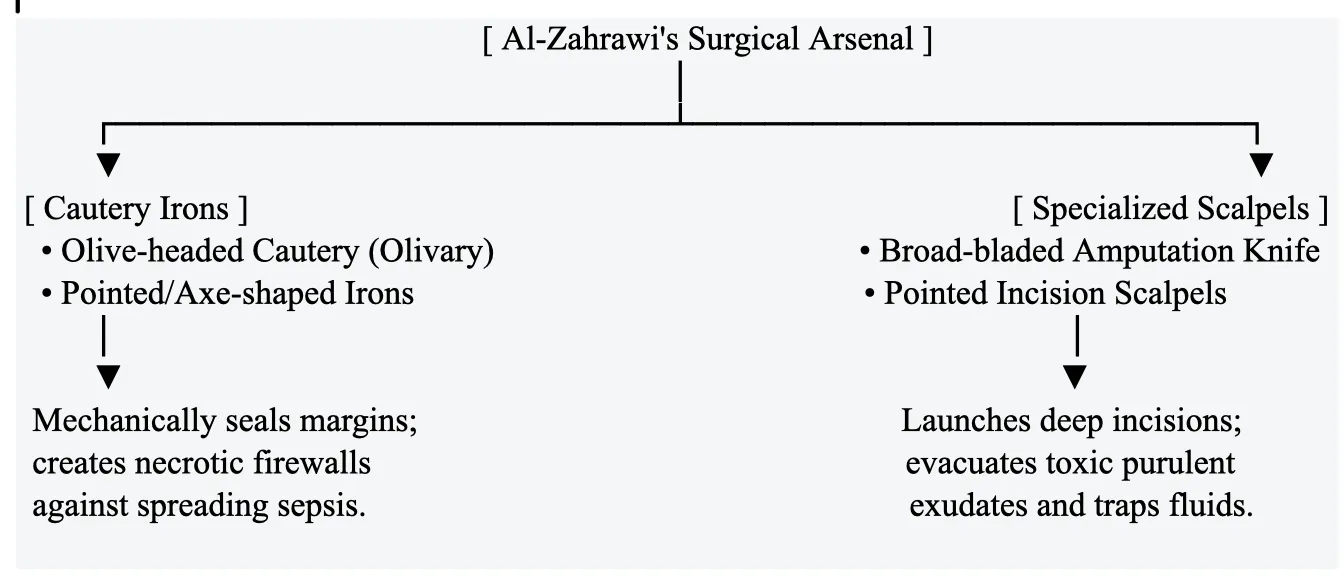
In his monumental 30-volume medical encyclopedia, Kitab al-Tasrif, Al-Zahrawi detailed over 200 surgical instruments—many of his own invention—designed specifically to mechanically manipulate these inflammatory states:
- The Olivary Cautery (Olive-Headed Iron): A specialized iron tool with a smooth, bulbous tip. Heated to a precise glow, it was pressed against leaking or inflamed tissue. The unique shape allowed the surgeon to deliver concentrated thermal energy to a pinpoint area, instantly sealing local capillaries without destroying surrounding healthy tissue.
- The Crescent and Axe-Shaped Irons: Designed to match the contours of different anatomical regions (such as the skull or joints). These allowed surgeons to create geometric “firewalls” around spreading, hot inflammatory margins, effectively isolating the infection.
- The Broad-Bladed Amputation Knife: Used when inflammation deteriorated into irreversible, necrotic gangrene. Its heavy, curved design allowed for a rapid, single-stroke cut through infected soft tissue, minimizing the time the patient was exposed to systemic shock.
- Pointed Incision Scalpels (Mishrat): Fine, ultra-sharp blades designed specifically for lanceting encapsulated Aram (abscesses). Instead of tearing tissue, these blades allowed for a clean, deep slit that safely evacuated trapped, toxic purulent exudates while preserving the structural integrity of the surrounding skin barrier.
Al-Razi (Rhazes) and the Resolution phase
Centuries before modern immunology defined how inflammation “resolves” to prevent chronic tissue damage; Al-Razi was documenting the natural timeline of infections.
When treating localized abscesses or systemic fevers, Al-Razi noted that inflammation was a necessary, active process. He warned other physicians against prematurely trying to freeze or suppress a “hot” swelling in its early stages. He argued that the body needed to go through the active inflammatory phase to “ripen” and expel the morbid matter.
The Modern Parallel: Today, we know that completely blocking acute inflammation with high dose anti-inflammatory drugs can impair tissue healing and delay macrophage switching (from the pro-inflammatory M1 phenotype to the healing M2 phenotype). Al-Razi understood this clinical balancing act purely through observational triage.
The Lesson for Gen Z Clinicians
Inflammation is currently the biggest buzzword in modern wellness. From TikTok “anti inflammatory diets” to biohackers taking ice baths to completely suppress their innate immune pathways, everyone is obsessed with erasing it.
But Islamic medical history reminds us of a fundamental pathological truth: inflammation is not the enemy; it is the response. It is your immune system actively fighting to restore homeostasis. As clinicians, your goal isn’t always to completely shut down the body’s natural defense alarms, but to understand, monitor, and guide them.
Fluid Classification: 11th-Century Humors vs. 21st-Century Pathology
Here is how Ibn Sina’s macro-observations of fluid dynamics map onto modern histopathology and exudate classifications:
| Ibn Sina’s Fluid
Category |
Classical
Description |
Modern Pathological
Equivalent |
Pathophysiological
Mechanism |
| Sanguineous (Dem) | Hot, bright red, rapid fluid accumulation | Serosanguineous /
Hemorrhagic Exudate |
Severe vascular damage causing capillary leakage and RBC extravasation. |
| Bilious (Safra) | Sharp, burning, spreading, yellowish fluid | Serous / Purulent
(Early Sepsis) |
Low-protein fluid or early neutrophilic infiltration produces acute, localized heat. |
| Phlegmatic
(Balgham) |
Slow, cold, boggy, pale accumulation | Transudate / Chronic
Edema |
Increased hydrostatic pressure or lymphatic blockage without active cellular recruitment. |
| Melancholic
(Sawda) |
Hard, indurated, non-yielding dark masses | Fibrinous Exudate /
Fibrosis / Granuloma |
High-fibrinogen leakage leads to dense fibrin networks, scarring, or walled-off chronic inflammation. |
Conclusion: The Cellular Legacy of Macro-Observations
When we look at a 21st-century pathology slide showing vasodilation, endothelial gaps, and leukocyte migration, we look at the micro-cellular reality of Ibn Sina and Al-Zahrawi’s macro observations. 1,000 years ago, without the aid of microscopes, chemical stains, or an understanding of microbiology, these physicians successfully deduced a fundamental truth: inflammation is not a random curse, but a calculated, defensive opening salvo.
By categorizing fluid exudates and inventing targeted surgical tools like specialized olivary cauteries to control them, Islamic Golden Age polymaths shifted medicine from passive observation to active modulation. They recognized that the human body actively fights for itself. In doing so, they built the conceptual bridge that modern immunology stands on today, proving that our current understanding of the immune response is deeply rooted in the brilliant clinical intuition of the past.
References & Further Reading
- Ibn Sina (Avicenna). Al-Qanun fi al-Tibb (The Canon of Medicine), Book III & IV. Completed c. 1025.
- Al-Zahrawi (Abulcasis). Kitab al-Tasrif li-man ‘ajiza ‘an al-ta’lif (The Method of Medicine), Volume 30: On Surgery. Completed c. 1000.
- Al-Ghazal, S. K. (2004). The Minaret of Surgical Progress: Al-Zahrawi (Abulcasis), The Pioneer of Modern Surgery. Islamic Medicine Organization.
- Pormann, P. E., & Savage-Smith, E. (2007). Medieval Islamic Medicine. Edinburgh University Press.
- Siraisi, N. G. (1987). Avicenna in Renaissance Italy: The Canon and Medical Education in the Universities after 1500. Princeton University Press.
Name: Dr S Adeeb Mujtaba Ali
DGI: Salar E Millat Research Centre
Designation: Research Officer (In-Charge)
Leave A Comment