
 By admin
The Silent Rise of a New Drug Crisis
While the opioid epidemic has consumed the world’s attention, another drug crisis has been quietly building in its shadow. Pregabalin and gabapentin — collectively known as gabapentinoids — are medications originally designed as anticonvulsants. Prescribed to over 50 million patients globally for neuropathic pain, anxiety, and epilepsy, they were long considered ‘safe’ alternatives to opioids. That assumption has proven dangerously wrong.
Our systematic review of 255 PubMed-indexed publications spanning 27 years (1999-2026) reveals a textbook case of an evolving drug misuse epidemic — one that has gone from 1 publication per year in its first decade to 41 publications in 2025 alone. More critically, the crisis is now exploding across the Global South, where community pharmacists represent the only viable frontline defence.
27 Years of Data Tell a Clear Story
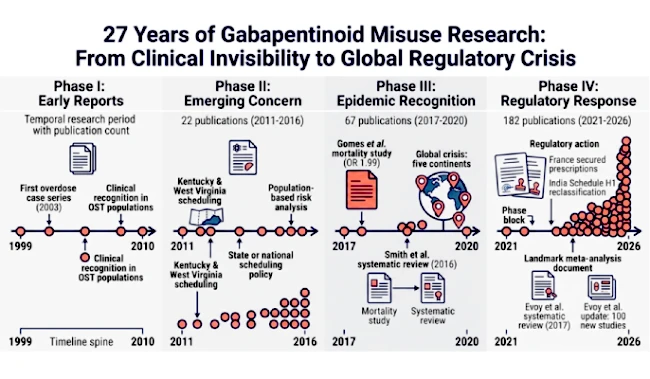
By combining two PubMed timeline datasets, we mapped the entire publication history of gabapentinoid misuse research from 1999 to 2026. The data reveals four distinct epidemiological phases:
- Phase I (1999-2010) — Early Reports: Just 5 publications in 12 years. The first gabapentin overdose case series appeared in 2003. Gabapentinoids were essentially invisible to the addiction medicine community.
- Phase II (2011-2016) — Emerging Concern: 22 publications. The first systematic review of gabapentin misuse was published by Smith et al. (2016) in Addiction. Clinicians began noticing that patients on opioid substitution therapy were disproportionately seeking gabapentinoids.
- Phase III (2017-2020) — Epidemic Recognition: 67 publications, a 3x increase. This phase was catalyzed by the landmark systematic review of Evoy et al. (2017) in Drugs, and by Gomes et al.’s (2017) population-based study demonstrating that gabapentin co-prescription with opioids nearly doubled the risk of opioid-related death (adjusted OR 1.99, 95% CI 1.61-2.47). Kentucky and West Virginia became the first US states to schedule gabapentin.
- Phase IV (2021-2026) — Regulatory Response: 182 publications, a 2.7x increase. A second systematic review update by Evoy et al. (2026) identified 100 new studies spanning five continents. France mandated secured prescriptions. India reclassified pregabalin under Schedule H1. The crisis went truly global.
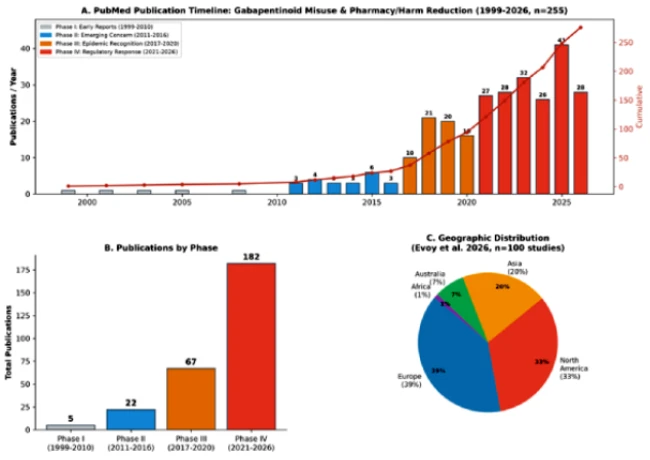
Figure 1: Epidemiological overview. (A) Complete PubMed publication timeline with cumulative growth curve (n=255). (B) Total publications by epidemic phase. (C) Geographic distribution of studies (Evoy et al. 2026).
Does Regulation Actually Work? A Meta-Analysis
Perhaps the most urgent question for policymakers is: does controlled substance reclassification actually reduce misuse? To answer this, we performed a meta-analysis of five interrupted time-series studies that evaluated national reclassification policies in Saudi Arabia, Egypt, France, and the United States.
The results are clear: reclassification works, but imperfectly.
Our pooled analysis showed a mean 39.8% reduction in gabapentinoid utilization following reclassification. France’s secured prescription mandate led to a 16.9% reduction in prevalent use and a remarkable 71.5% reduction in incident misuse (Munech-Herran et al., 2026). Egypt’s reclassification was even more dramatic — pregabalin sales plummeted by 99%. But here lies the cautionary tale: gabapentin sales simultaneously surged by 198%. Patients simply switched to the unregulated alternative. This ‘substitution effect’ is the Achilles’ heel of single-drug scheduling policies.
In the United States, West Virginia’s Schedule V classification of gabapentin was associated with an immediate decrease of 0.39 gabapentin-involved fatal overdoses per 100,000 adults (95% CI: -0.75, -0.03) — real lives saved through real policy.
Case Study: India’s Move to Schedule H1 (May 2026)
On May 13, 2026, the Ministry of Health and Family Welfare in India issued official notification G.S.R. 377(E), officially moving pregabalin to Schedule H1 of the Drugs Rules. This decisive regulatory action was driven by alarming reports from various states regarding rampant misuse, particularly among the youth seeking its sedative and euphoric effects, as well as instances of illegal trafficking. Under Schedule H1, pregabalin can now only be dispensed against a valid prescription from a Registered Medical Practitioner. Furthermore, pharmacies must maintain a separate sales register recording patient and doctor details, and manufacturers must prominently display a ‘Schedule H1 Drug Warning’ on the packaging.
While this is a monumental step for harm reduction in the Indian Subcontinent, a critical gap remains: gabapentin was left out of this reclassification. As we observed in Egypt, where a 99% drop in pregabalin sales following restrictions was immediately offset by a 198% surge in gabapentin sales, India now faces the imminent risk of a massive substitution effect. Community pharmacists across India must be hyper-vigilant for a sudden spike in gabapentin requests as users migrate to the unregulated alternative.
The Pharmacist as Gatekeeper
In the Global South, the community pharmacy is often the most — and sometimes the only — accessible point of healthcare. Our review identified five evidence-based harm reduction strategies that pharmacists can deploy immediately:
| Strategy | Evidence | Impact |
| Prescription Monitoring & Schedule Enforcement |
Saudi: -1.85 DDD/TID; France: -71.5% incident misuse |
Directly curbs unauthorized access and diversion |
| Dispensing Vigilance | Egypt: 99% pregabalin drop; But 198% gabapentin surge |
Effective only if BOTH gabapentinoids are monitored |
| Patient Education | 72.1% of Australian pharmacies receive gabapentinoid Rx daily (Jung 2026) |
Prevents accidental polysubstance overdose |
| Screening & Referral | 66.6% of Pakistani users aged 18-27, all male (Hafeez 2026) |
Targets high-risk demographic for tapering |
| Deprescribing Support | Scoping review found major evidence gaps (Anderson 2023) |
Identifies long-term users for structured dose reduction |
Table 1: Evidence-based pharmacist-led harm reduction strategies with data extracted from included studies.
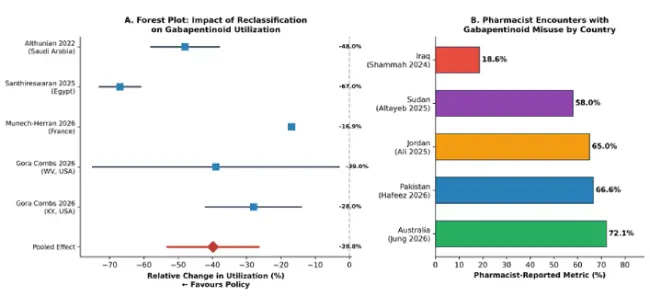
Figure 2: Meta-analysis and pharmacist data. (A) Forest plot showing the impact of controlled substance reclassification on gabapentinoid utilization across 5 national policy studies. (B) Pharmacist-reported encounters with gabapentinoid misuse by country.
The Global South Needs a Different Playbook
The demographic profile of misuse in the Global South is strikingly different from the West. In Pakistan, Hafeez et al. (2026) found that 100% of non-prescription pregabalin users were young males (66.6% aged 18-27), driven by workplace peer pressure — not chronic pain or opioid dependency. In Iraq, Shammah et al. (2024) found that 18.6% of pharmacists identified gabapentinoids as the most commonly misused prescription drug. In Turkiye, wastewater-based epidemiology detected pregabalin in all 31 major cities tested, with population-normalized intake reaching 2,604 mg per 1,000 people per day in some areas.
These are not patients abusing their own prescriptions. These are young people buying gabapentinoids over the counter for recreational euphoria. The intervention model must therefore shift from ‘deprescribing’ to ‘preventing unauthorised access’ — and the community pharmacist is the only realistic gatekeeper.
What Must Change
Our analysis of 255 studies across 27 years leads to three actionable recommendations:
- Schedule the class, not just the compound. Egypt’s experience proves that scheduling pregabalin alone simply redirects misuse to gabapentin. India’s recent May 2026 move to place pregabalin under Schedule H1 while leaving gabapentin unregulated risks triggering the same substitution effect. Both gabapentinoids must be regulated simultaneously.
- Invest in pharmacist training. Despite 72.1% of Australian pharmacies dispensing gabapentinoids daily, confidence in deprescribing remains low. Pharmacists in the Global South need structured intervention protocols, not just regulatory mandates.
- Target the young male demographic. The misuse profile in Pakistan, Jordan, and Iraq is fundamentally different from Western patterns. Harm reduction strategies must be culturally adapted to address peer-driven recreational use among young men.
Conclusion
The gabapentinoid misuse epidemic is real, accelerating, and global. From 1 publication in 1999 to 41 in 2025, the scientific community has documented a crisis that can no longer be ignored. Controlled substance reclassification achieves a meaningful ~40% reduction in utilisation — but only pharmacist-led harm reduction can address the substitution effects, polysubstance dangers, and the unique demographic drivers in the Global South. The community pharmacist is not a bystander in this epidemic. They are the last line of defence.
Key References:
- Evoy KE et al. Drugs. 2026;86(8):1365-78. PMID: 42236659
- Evoy KE et al. Drugs. 2017;77(4):403-26. PMID: 28144823
- Gomes T et al. PLoS Med. 2017;14(10):e1002396. PMID: 28972983
- Santhireswaran A et al. PLoS One. 2025;20(12):e0337833. PMID: 41348804
- Althunian TA et al. Pharmacoepidemiol Drug Saf. 2022;31(5):577-82. PMID: 35049110
- Munech-Herran M et al. Br J Clin Pharmacol. 2026;92(7):2212-19. PMID: 41724732
- Gora Combs K et al. Drug Alcohol Depend. 2026;285:113189. PMID: 42155429
- Hafeez MM et al. Subst Abuse Treat Prev Policy. 2026;21(1):35. PMID: 41928239
- Jung M et al. Br J Clin Pharmacol. 2026;92(6):1911-21. PMID: 41636468
- Smith RV et al. Addiction. 2016;111(7):1160-74. PMID: 27265421
Dr. Umair Waehdi, PharmD, (PhD)
Research Assistant, SEMRC
Systematic Review & Meta-Analysis of 255 PubMed-Indexed Studies (1999-2026)
Leave A Comment