
 By admin
1. THE CELLULAR ENGINE AND THE INHERITED SHADOW
Every cell in our body relies on tiny microscopic powerhouses called mitochondria to generate over 90% of the energy (ATP) we need to survive. While our main genetic blueprint (nuclear DNA) resides safely in the nucleus, mitochondria carry their own tiny, circular genome—mitochondrial DNA (mtDNA)—made of just 37 genes dedicated to keeping the cellular power plants running.
When a baby is conceived, sperm mitochondria are marked and destroyed by the egg. As a result, mitochondria are passed down strictly through the maternal line. If a mother carries faulty mutations in her mtDNA, she will unavoidably pass those damaged batteries to all of her children.
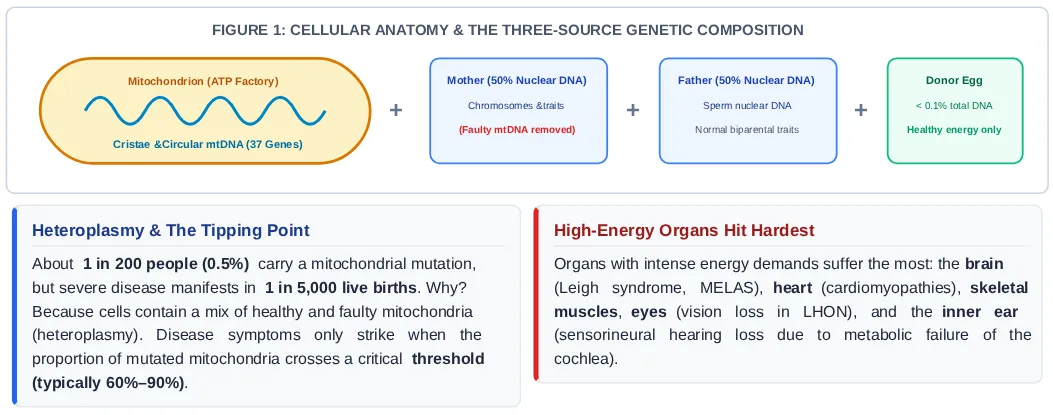
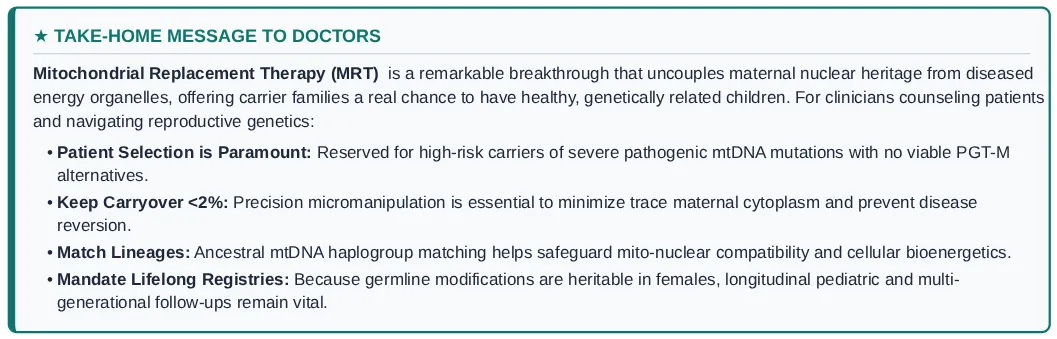
When a carrier mother has a high mutation load across all her eggs, conventional embryo screening cannot help. Mitochondrial Replacement Therapy (MRT) steps in as an innovative medical alternative—allowing mothers to conceive healthy children who share their nuclear DNA without transmitting fatal mitochondrial defects.
2. REWIRING THE BLUEPRINT: THE MAIN CLINICAL TECHNIQUES
The core strategy of MRT is straightforward: take the parents’ nuclear DNA (which dictates appearance, personality, and physical traits) and transplant it into a healthy donor egg whose nucleus has been removed. This gives the child nuclear genes from their mother and father, and clean cellular power plants from the donor.
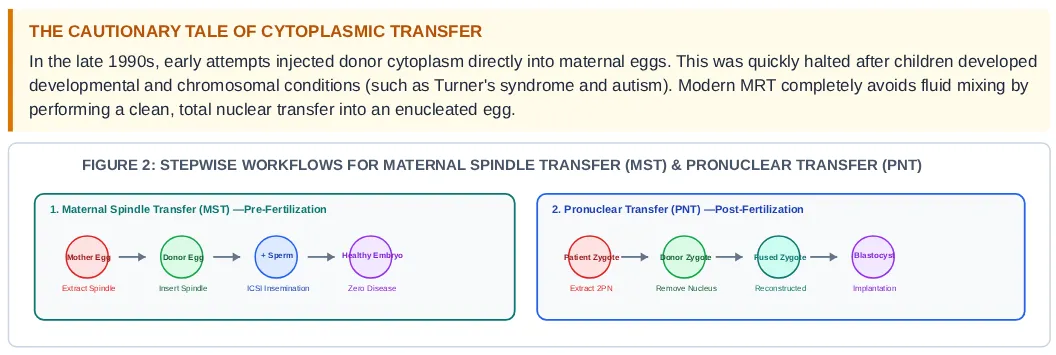
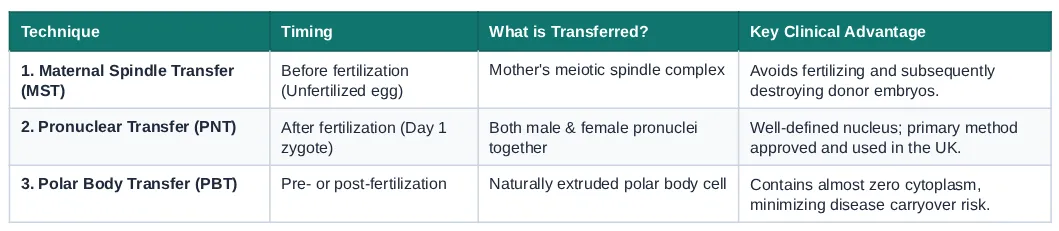
Today, fertility specialists rely on three primary microsurgical routes:
- Maternal Spindle Transfer (MST): Done before fertilization. The mother’s meiotic spindle (nuclear DNA) is gently extracted from an unfertilized egg and placed into an enucleated donor egg. It is then fertilized with the father’s sperm via ICSI and grown into an embryo.
- Pronuclear Transfer (PNT): Done after fertilization. Both the patient’s egg and donor egg are fertilized. Before the first cell division, the paired parental pronuclei are extracted and transferred into the enucleated donor zygote.
- Polar Body Transfer (PBT): An emerging method that transfers the naturally discarded “polar body”—a small nuclear package containing virtually zero cytoplasm—minimizing the risk of accidentally transferring faulty maternal mitochondria.
3. THE UNRESOLVED QUESTIONS & BIOLOGICAL VARIABLES
Even with exquisite precision under the microscope, replacing cellular power plants introduces complex biological challenges:

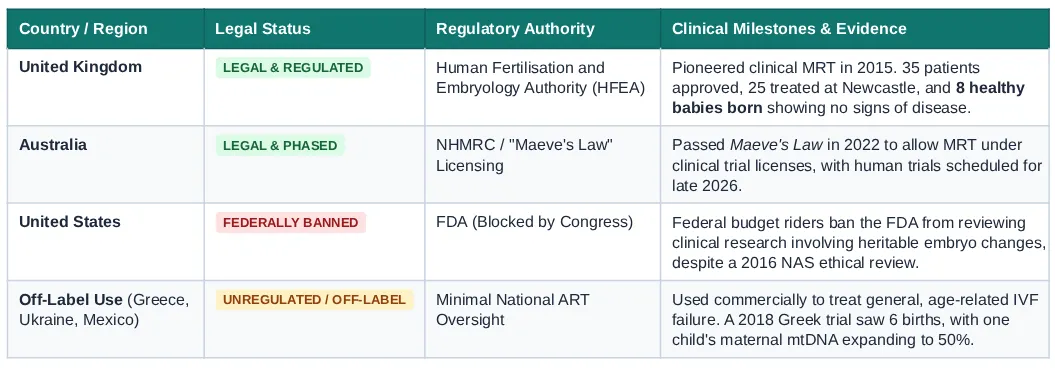
4. A DIVIDED WORLD: GLOBAL REGULATORY LANDSCAPES
Countries around the globe have taken strikingly different legal stances on MRT:
5. ETHICAL, SOCIETAL, AND RELIGIOUS CONSIDERATIONS
Because female offspring will pass their donor mitochondria to future generations, MRT creates heritable changes in the human germline, sparking deep debate:

Presentation by: Dr. Syeda Ayesha
Designation: Associate professor
Department of: Otorhinolaryngology
Leave A Comment