 By admin
Every year on November 14th, the world marks World Diabetes Day. For 2026, the theme carries real urgency: “Early Action on Diabetes.” It’s not just a slogan — it’s a two-year campaign (2026–27) built around a sobering fact: diabetes currently affects over half a billion people worldwide, and almost one in two of them remain undiagnosed.
That statistic alone should stop us in our tracks. Half of the people living with this condition don’t even know they have it.
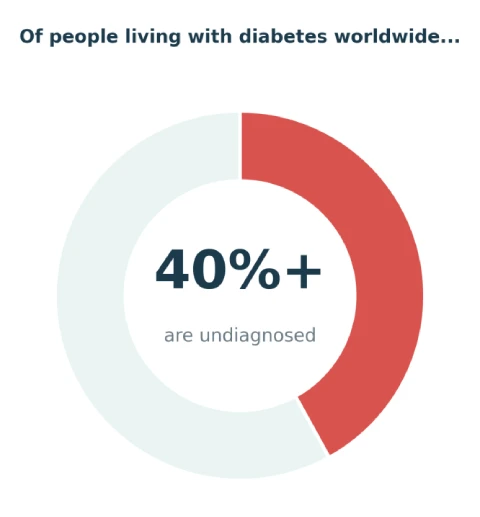
More than 40% of people living with diabetes worldwide are undiagnosed. (Source: WHO, IDF)
The Scale of the Problem
Diabetes isn’t slowing down. It’s one of the world’s fastest-growing health challenges, with projections showing the number of people living with diabetes could reach 853 million by 2050. Just as concerning, roughly 1 in 8 people worldwide are already at high risk of developing type 2 diabetes, yet many face persistent barriers to managing their risk factors.
Think about that for a moment. This isn’t a distant, future problem — it’s already sitting quietly in a huge share of the global population, undetected and unmanaged.
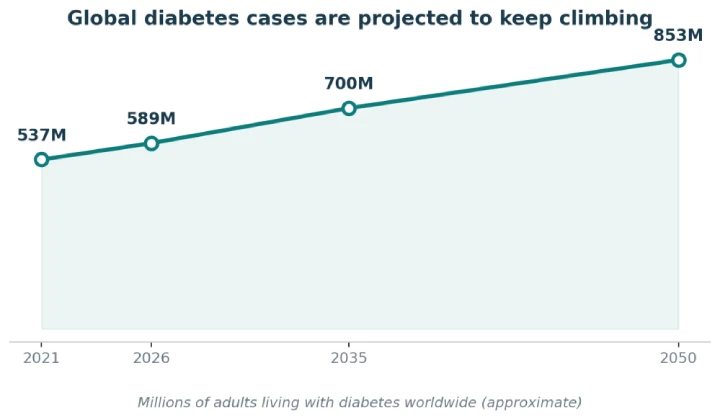
Global diabetes cases are projected to keep rising sharply through 2050. (Source: International Diabetes Federation)
Why “Early” Is the Whole Point
The 2026–27 campaign isn’t about diabetes in general — it’s specifically about timing. The push leading up to November 14th centers on early diagnosis and reducing risk before complications set in.
Here’s why that matters so much medically: catching diabetes in its early stages can prevent life threatening events like diabetic ketoacidosis, and can prevent or delay serious complications including heart disease, kidney failure, vision loss, and nerve damage. By the time symptoms become impossible to ignore, damage may already be underway — in fact, a significant share of people with type 2 diabetes already have complications by the time they’re diagnosed.
The Prediabetes Blind Spot
This is where screening becomes critical. Prediabetes — elevated blood sugar that hasn’t yet crossed into full diabetes — is often completely silent. There’s no dramatic symptom that sends someone to the doctor. It’s discovered almost exclusively through testing.
That’s a huge opportunity. Understanding personal risk factors and getting early support from healthcare professionals is key to preventing or delaying the onset of type 2 diabetes altogether. Simple, low-cost screening tools — a fasting blood glucose test, an HbA1c test, or even a basic risk questionnaire — can catch prediabetes years before it progresses.
And the barriers aren’t purely medical. Urban living, air pollution, limited opportunities for physical activity, and easy access to unhealthy food all make it harder for many people to adopt the habits that reduce risk. Effective screening programs have to account for these real-world obstacles, not just hand out pamphlets about diet and exercise.
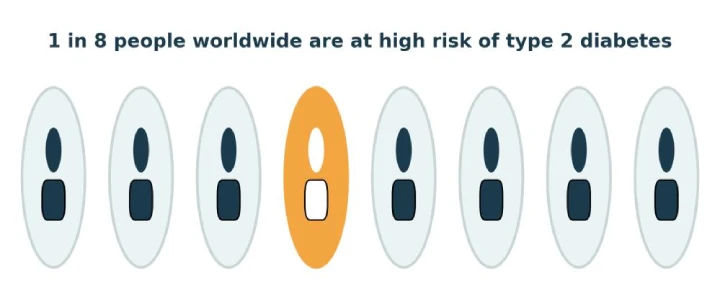
1 in 8 people worldwide are at high risk of developing type 2 diabetes. (Source: International Diabetes Federation)
Recognizing the Warning Signs
Even without formal screening, awareness of symptoms saves lives. Common symptoms of diabetes include increased thirst, frequent urination, tiredness, and blurred vision. But the two main types don’t behave the same way — type 1 diabetes often develops rapidly, while type 2 typically develops gradually and may cause few or no noticeable symptoms at all.
That gradual, symptom-light progression of type 2 diabetes is exactly why it hides in plain sight for so long, and exactly why routine screening matters more than waiting for symptoms to appear.
Type 1 diabetes has its own awareness gap too — it can develop at any age and is frequently missed or misdiagnosed, particularly in adults, since many people still assume it’s purely a childhood condition.
A Global Target Worth Knowing
There’s an official benchmark behind this campaign. WHO Member States have set a target for 80% of people with diabetes to be diagnosed by 2030, as one of five global diabetes coverage goals. Closing that diagnosis gap isn’t just a health ministry statistic — it translates directly into millions of people gaining access to treatment, monitoring, and support they currently don’t have.
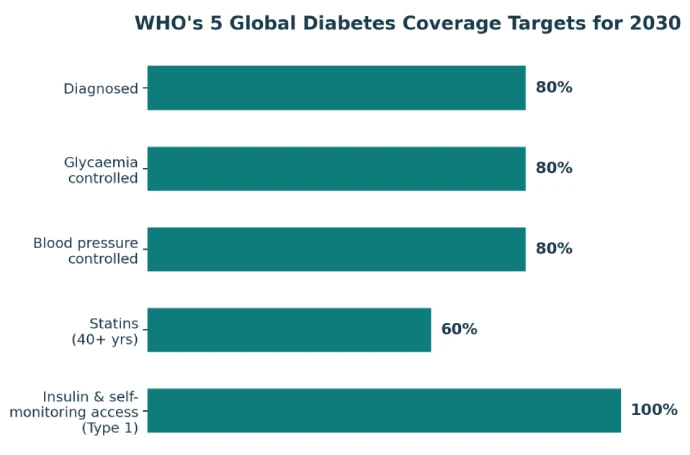
WHO’s five global diabetes coverage targets, to be reached by 2030. (Source: World Health Organization)
What This Means at the Community Level
The good news is that early action doesn’t require sophisticated infrastructure everywhere. Around the world, communities are already building this into local events — the Global Diabetes Walk campaign, for instance, is encouraging organizers to pair their walks with an actual screening or awareness activity rather than just a symbolic gesture. Similar efforts are combining public walks with free diabetes screening services to make testing accessible at the same moment awareness is being raised.
That combination — awareness plus actual access to a test — is the model worth replicating. Awareness alone doesn’t diagnose anyone. Screening without awareness means people don’t show up. You need both.
What You Can Actually Do
- Know your numbers. If you haven’t had a blood sugar or HbA1c check recently — especially if you have risk factors like family history, being overweight, or a sedentary lifestyle — ask your doctor about it at your next visit.
- Learn the symptoms, even the subtle ones, and don’t dismiss persistent thirst, fatigue, or blurred vision as “just getting older” or “just stress.”
- Support community screening events in your area, or organize one — pairing awareness campaigns with real testing has proven far more effective than messaging alone.
- Talk about it. Stigma is one of the reasons people delay getting tested or avoid seeking care after diagnosis. Normalizing the conversation is part of early action too.
Diabetes doesn’t announce itself loudly in its early stages — that’s precisely the problem this year’s theme is trying to solve. The tools to catch it early already exist. What’s needed now is the collective will to use them before complications, not after.
References
- WHO – World Diabetes Day 2026 campaign page — https://www.who.int/campaigns/world-diabetesday/2026
- International Diabetes Federation – World Diabetes Day 2026–27: Early Action on Diabetes — https://idf.org/news-and-resources/news/wdd-2026-27/
- World Diabetes Day official campaign site (worlddiabetesday.org) — https://worlddiabetesday.org/
- Global Diabetes Walk 2026 – World Diabetes Foundation — https://worlddiabetesday.org/activities/events/global-diabetes-walk/
- World Diabetes Day background & WHO global diabetes coverage targets — https://en.vikaspedia.in/viewcontent/health/health-campaigns/important-days/world-diabetes-day
By,
Name: Dr. S Adeeb Mujtaba Ali
Designation: Research Officer (In-Charge)
DGI: Salar E Millat Research Centre
Leave A Comment