
 By admin
Long before glucose meters, insulin pens, or HbA1c tests, physicians across the ancient world were already puzzling over a strange illness: one that made people pass unusually large amounts of urine, left them constantly thirsty, and wasted their bodies away. They had no microscopes, no chemistry labs, and no concept of a pancreas producing insulin — yet across Egypt, India, Greece, China, and eventually the Islamic world, they built up a remarkably detailed picture of the disease we now call diabetes.
Nowhere was that picture sharpened more than in the Islamic Golden Age, particularly in the hands of one towering figure: Ibn Sīnā, known in the West as Avicenna. Here’s how our understanding of diabetes evolved, step by step, from an Egyptian scroll to a Persian medical encyclopedia that ruled the world’s universities for 500 years.
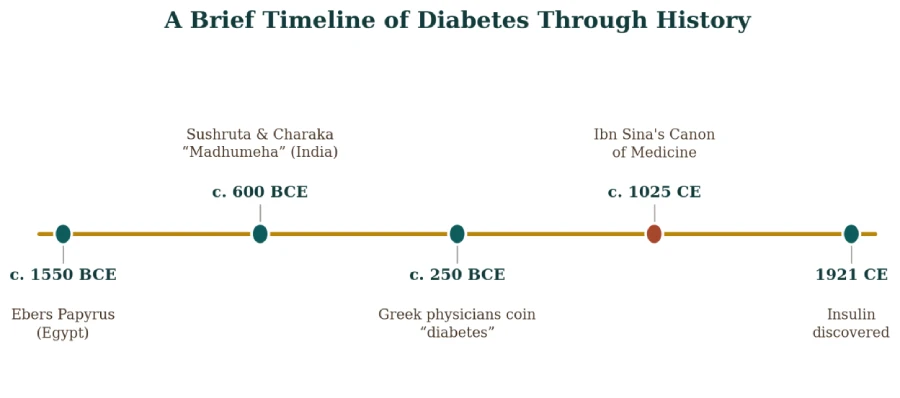
Key milestones in the ancient and medieval history of diabetes.
Ancient Egypt: The First Written Clue
The earliest known reference to a diabetes-like illness appears in the Ebers Papyrus, an Egyptian medical text dated to around 1550 BCE, though some of its content may draw on material centuries older still. The papyrus describes remedies aimed at a patient producing urine that was “too plentiful,” alongside a wasting of the flesh. Historians still debate exactly which condition this passage refers to — excessive urination has many causes — but it remains one of the oldest surviving medical descriptions that plausibly touches on diabetes.
The treatments prescribed were largely dietary: decoctions of wheat grain, fruit, and other plant based ingredients, given over several days. There was no understanding of a cause, only an attempt to manage a visible symptom.
Ancient India: “Honey Urine” and the Ant Test
Several centuries later, physicians of the Ayurvedic tradition in India made a much sharper observation. Around the 5th and 6th centuries BCE, Sushruta and Charaka described a condition they called madhumeha, or “honey urine.” They noted not just that the urine was unusually abundant, but that it was sweet, sticky to the touch, and — famously — attracted ants and flies.
This was, in effect, the world’s first clinical test for diabetes: if insects gathered around a patient’s urine, physicians took it as a diagnostic sign. Sushruta also linked the condition to body weight and lifestyle, associating it particularly with people who were sedentary and heavier-set — an early, intuitive connection to what we would now call type 2 diabetes.
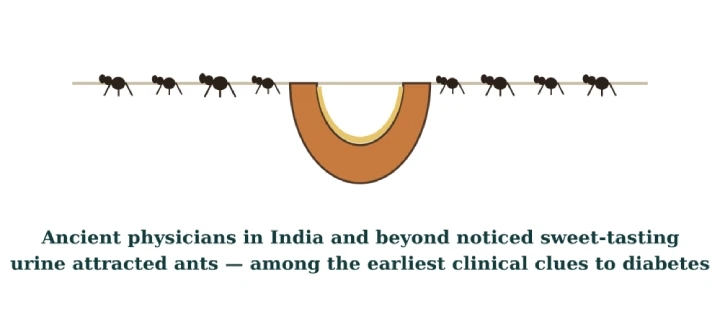 The “ant test”: one of the earliest clinical diagnostic methods in medical history.
Ancient Greece and China: Naming the Disease
The word “diabetes” itself comes from ancient Greece, from a verb meaning “to pass through,” like a siphon — a fitting description of the relentless urination that defines the disease. The term is credited to Greek physicians around the 3rd century BCE, and a couple of centuries later the physician
Aretaeus of Cappadocia gave one of the more detailed clinical descriptions of the disease’s progression, capturing its wasting, thirst, and eventual decline.
Independently, in traditional Chinese medicine, physicians described a strikingly similar condition known as xiāo kě — “wasting-thirst” — characterized by excessive hunger, thirst, frequent urination, and weight loss. Neither Greek nor Chinese physicians understood the underlying cause, but their descriptions of the symptom pattern were remarkably consistent with what physicians elsewhere were independently observing.
The Islamic Golden Age: From Observation to System
By the time the Islamic Golden Age was in full swing (roughly the 8th to 13th centuries CE), physicians in Baghdad, Bukhara, and beyond had inherited the accumulated medical knowledge of Greece, Persia, India, and Egypt — and they didn’t just preserve it. They tested it, organized it, expanded it, and in many cases corrected it.
One of the towering figures of this era was Abu Bakr al-Rāzī, known in the West as Rhazes (c. 865 925 CE), chief physician at a major hospital in Baghdad and one of the most original clinical minds of the medieval world. Al-Rāzī’s vast medical encyclopedia, Al-Hāwī, synthesized Greek, Persian, Indian, and Arabic medical knowledge into a single, searchable body of clinical case notes, setting a standard for rigorous, symptom-by-symptom observation that shaped how later physicians approached diseases like diabetes.
But it was Al-Rāzī’s successor by a century, Ibn Sīnā, who would take the study of diabetes further than anyone before him.
Ibn Sīnā (Avicenna): The “Prince of Physicians”
Ibn Sīnā (980–1037 CE), a Persian polymath known in Latin as Avicenna, wrote on an almost unbelievable range of subjects — philosophy, astronomy, theology, mathematics — but his lasting fame in medicine rests on one monumental work: Al-Qānūn fī al-Tibb, or The Canon of Medicine, completed around 1025 CE. This five-volume encyclopedia brought together the medical knowledge of Hippocrates, Galen, Aristotle, and Al-Rāzī alongside Avicenna’s own clinical observations, and it went on to dominate medical education in both the Islamic world and Europe for roughly 500 years after being translated into Latin in the 12th century.
Within the Canon, Avicenna’s treatment of diabetes was extraordinarily advanced for its time.
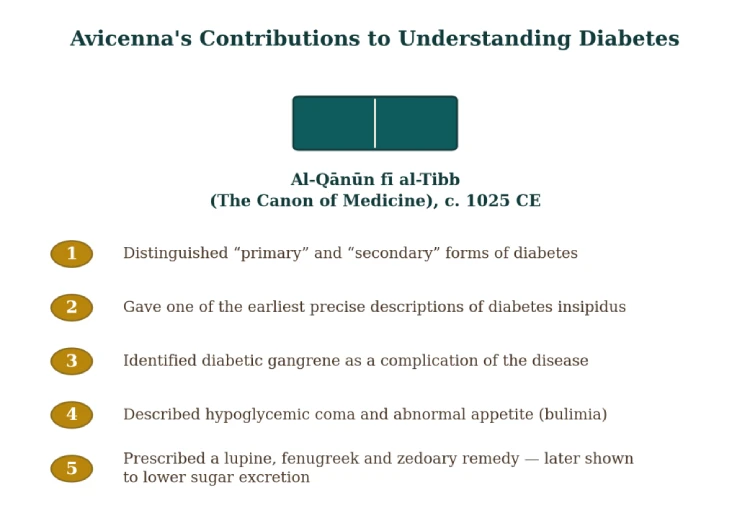
Avicenna’s key observations on diabetes, as recorded in the Canon of Medicine.
Distinguishing Types of Diabetes
Avicenna described diabetes with the same core symptoms noted by Aretaeus centuries earlier — abnormal thirst, excessive appetite, and sweet-tasting urine — but he went further, describing what he called primary and secondary forms of the disease, an early conceptual step toward the distinction modern medicine draws between different underlying causes of diabetes.
Identifying Diabetes Insipidus
In his chapter on polyuria, Avicenna worked through the differential diagnosis of excessive urination across more than twenty different conditions. Among them, he gave a remarkably precise description of what we now call diabetes insipidus — a completely different condition from diabetes mellitus, involving excess urination without the telltale sweetness. This distinction would not be formally established in European medicine for many centuries afterward.
Recognizing Complications
Avicenna also connected diabetes to some of its serious downstream effects. He documented diabetic gangrene as a complication of the disease, alongside a decline in sexual function — both signs of the long-term damage that untreated diabetes can cause. He additionally gave a detailed account of hypoglycemic coma and abnormal, insatiable appetite, showing an understanding that blood sugar could swing dangerously in both directions.
A Herbal Treatment That Actually Worked
Perhaps most striking to modern readers: Avicenna prescribed a remedy combining lupine, fenugreek (trigonella), and zedoary seed for diabetic patients. When researchers revisited this formula in modern times, they found that it produced a measurable reduction in sugar excretion — a rare case where a thousand-year-old prescription holds up, at least in part, under contemporary scrutiny.
Fenugreek in particular remains a subject of ongoing nutritional research today.
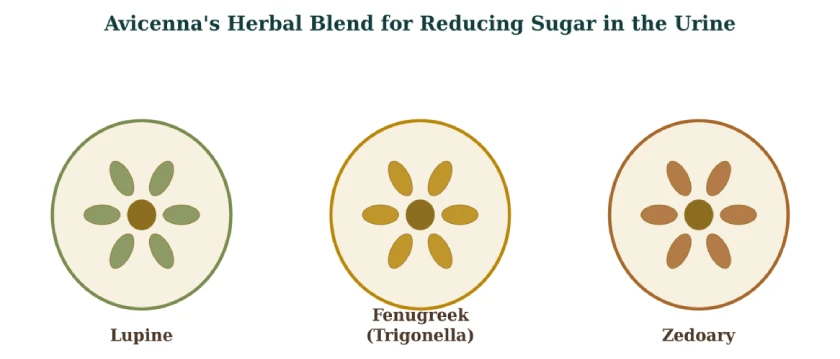
The three-herb blend Avicenna prescribed for diabetic patients.
A Legacy That Outlasted Empires
The Canon of Medicine wasn’t just influential — it was foundational. First printed in Latin in 1473, it remained a standard textbook in European medical schools well into the 16th and 17th centuries, and it continues to inform the practice of Unani medicine today. For half a millennium, students of medicine from Cordoba to Cambridge learned about diabetes largely through Avicenna’s framework: its symptoms, its complications, and its treatment.
What’s remarkable, looking back, is how much these ancient and medieval physicians got right using nothing but careful observation. They couldn’t see a pancreas fail or measure a blood glucose level, but they could watch a patient closely enough to notice sweetness in urine, ants gathering at a bowl, gangrene setting into a limb, or the sudden confusion of a hypoglycemic episode — and they organized those observations into frameworks that guided medical practice for centuries.
That thread — careful observation leading to earlier recognition and better outcomes — is the same one running through today’s push for early diabetes screening. The tools have changed almost beyond recognition, but the underlying instinct that Avicenna, Sushruta, and Al-Rāzī shared a thousand years ago is exactly the one still driving modern public health campaigns: the earlier you catch it, the better a person’s life will be.
References
- Wikipedia – History of Diabetes — https://en.wikipedia.org/wiki/History_of_diabetes
- Hektoen International – “The Pissing Evil” Before Insulin, by J.M.S. Pearce — https://hekint.org/2025/09/08/the-pissing-evil-before-insulin/
- International Journal of Endocrinology and Metabolism – Clinical views of Iranian scholars on endocrinology (Avicenna, Al-Rāzī) — https://applications.emro.who.int/imemrf/Int_J_Endocrinol_Metab/Int_J_Endocrinol_Metab_2003_1_1_43_45.pdf
- University of Virginia, Claude Moore Health Sciences Library – Avicenna (980–1037) — https://exhibits.hsl.virginia.edu/treasures/avicenna-980-1037/
- EBSCO Research Starters – Biography of Al-Rāzī (Rhazes) — https://www.ebsco.com/researchstarters/biography/al-razi
- Wikipedia – Abu Bakr al-Rāzī (Rhazes) — https://en.wikipedia.org/wiki/Abu_Bakr_al-Razi
- Diabetes on the Net – A history of diabetes and obesity (dip1-4-141-5) — https://diabetesonthenet.com/wp-content/uploads/dip1-4-141-5.pdf
By,
Name: Dr. S Adeeb Mujtaba Ali
Designation: Research Officer (In-Charge)
DGI: Salar E Millat Research Centre
Leave A Comment