
 By admin
Introduction
For over a century, oil has been the lifeblood of the global economy, shaping wars, fortunes, and politics. In the digital era, “Data is the New Oil” became the mantra of innovation. Now, a new reality is emerging: Water is the New Oil.
Unlike oil, water has no substitute. Human life, agriculture, industry, power generation, and healthcare all depend on a continuous supply of clean water. As climate change, urbanization, industrial growth, and population increase strain freshwater resources, water is becoming one of Earth’s most valuable assets. Nations that secure sustainable water supplies will enjoy economic stability, while water-stressed regions may face food insecurity, migration, and economic decline.
Why Water is Becoming the New Oil
- Growing Population: With the world approaching 10 billion people by 2050, demand for drinking water, sanitation, food, and industrial goods is rising sharply.
- Climate Change: Longer droughts, irregular rainfall, melting glaciers, and falling groundwater levels are shrinking supply while demand grows.
- Rapid Urbanization: Expanding cities consume enormous quantities of water for households, industry, and construction.
- Agricultural Demand: Agriculture uses about 70% of global freshwater withdrawals, and rising food demand increases irrigation needs.
- Industrial Expansion: Sectors like semiconductors, pharmaceuticals, textiles, and steel require vast quantities of clean water.
Future Problems Caused by Water Scarcity
Water shortages can trigger food inflation (lower crop yields, rising prices), industrial disruptions (factories can’t operate without water), an energy crisis (hydro, thermal, and nuclear plants need water), migration and social conflict over dwindling resources, and broader economic slowdown as agriculture, industry, and public health all suffer.
Financial Implications
Water scarcity isn’t just an environmental issue—it’s an investment opportunity. Governments are expected to invest trillions in water infrastructure, desalination, wastewater recycling, smart irrigation, leak detection, and water quality monitoring. Companies in these sectors—treatment, infrastructure, pumps, pipes, smart water tech, filtration, and desalination—are positioned for long-term growth, making water one of the fastest-growing infrastructure sectors of coming decades.
How Individuals Can Protect Themselves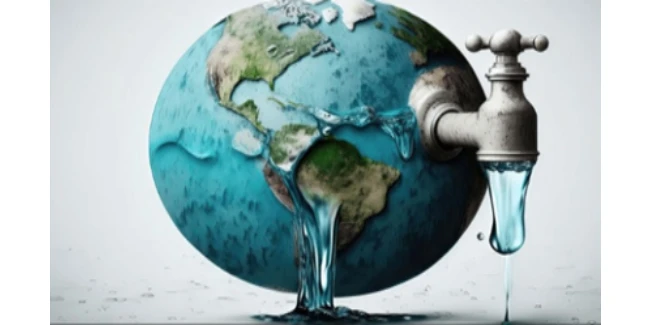
Households should start conserving now:
✔ Install rainwater harvesting systems
✔ Fix leaks immediately
✔ Use water-efficient appliances
✔ Recycle grey water for gardening
✔ Plant drought-resistant vegetation
✔ Store emergency drinking water
✔ Reduce unnecessary consumption
How Investors Can Profit from the Water Economy
- Water Infrastructure – reservoirs, pipelines, treatment plants benefiting from government spending
- Water Technology – AI, IoT, and sensors for leak detection and quality monitoring
- Desalination – expanding in water-scarce countries
- Agricultural Technology – precision irrigation to cut water use and boost yields
- Water ETFs – diversified exposure to global water-sector companies
- ESG Investing – rewarding companies with responsible, sustainable water practices
The Role of Technology
AI-driven leak detection, smart meters, satellite monitoring, drone-based irrigation, automated purification, and digital twins for water networks are reducing waste and improving efficiency—while opening new business opportunities.
Challenges Ahead
High infrastructure costs, water pricing regulation, environmental concerns, unequal access, aging pipelines, groundwater depletion, and climate uncertainty all remain significant obstacles requiring cooperation among governments, industries, and citizens.
Conclusion
The world has entered an era where water is becoming one of its most strategically vital resources. Just as oil fueled industrialization and data powered the digital age, water will underpin the sustainability of economies and societies ahead. For individuals, conservation is now essential for future security; for governments, resilient water infrastructure is a national priority; for investors, the water economy offers one of the most promising long-term growth opportunities of the century.
As the saying goes: “The wars of the 20th century were fought over oil. The economic battles of the 21st century may well be shaped by access to clean water.” Those who act early—conserving water and investing in sustainable solutions—will be best positioned for a future where every drop counts.
Dr. Mateen Ahmed Siddiqui
Professor and Vice Principal
Deccan School of Management
Leave A Comment