
 By admin
Allergic Rhinitis (AR), commonly referred to as “hay fever” or “seasonal allergy,” is an IgE mediated inflammatory condition primarily resulting from inflammation of the nasal mucosa. This leads to symptoms including sneezing, nasal blockage, itching around the nose, eyes, and ears, as well as eye redness. The condition typically occurs when individuals with AR inhale airborne allergens like pollen, dust, or mold, which provoke an immune response and trigger inflammation.
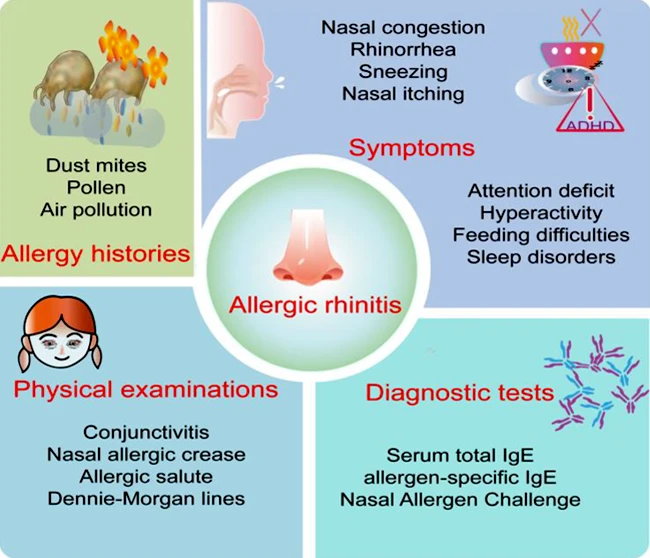
Image Source:
https://www.frontiersin.org/journals/immunology/articles/10.3389/fimmu.2024.1452410/full#f1
AI in Allergic Rhinitis:
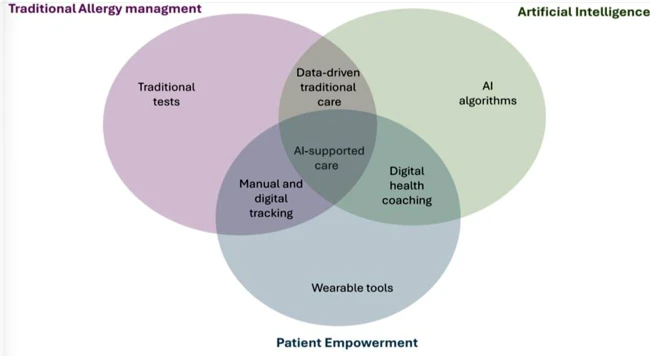
Image source: https://www.sciencedirect.com/science/article/pii/S2213219825008505
Artificial Intelligence has recently emerged as a significant advancement in healthcare, serving as a powerful tool for understanding and diagnosing diseases. Today’s AI technologies have advanced to the point where they can operate with minimal human intervention. Traditional diagnosis typically relies on a patient’s medical history, symptom evaluation, laboratory tests for allergen detection, and medical imaging. However, AI enables a more in-depth diagnostic
approach through specialized models designed to identify underlying causes more effectively.
AI systems benefit from highly accurate databases and clinical decision support tools driven by artificial intelligence, showcasing strong potential in improving diagnostic decisions. These AI models are trained using molecular Ig-E testing data combined with patients’ clinical histories, allowing the creation of electronic clinical records that support faster and more precise diagnoses.
Types of AI Models used in creation of Apps or Devices in detection of pathogens causing Allergic Rhinitis:
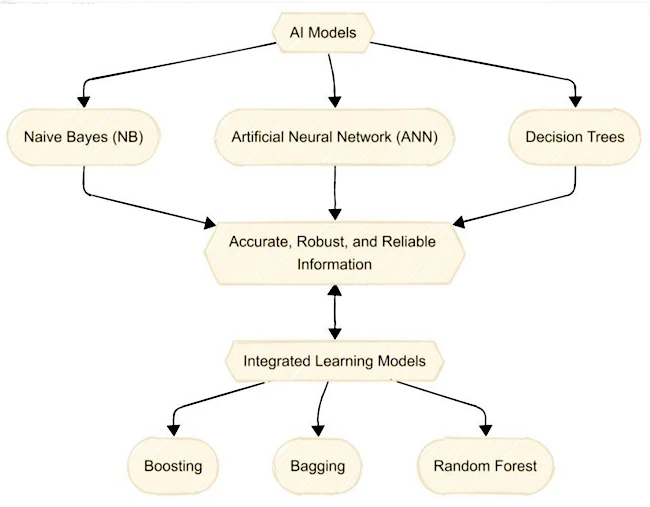
AI diagnosis outperforms clinicians:
Allergic Rhinitis relies on the detection of allergens through methods like:
- The skin prick test
- Blood total IgE test
- Specific IgE test (sIgE)
- Nasal secretion smear
- IgE analysis in nasal lavage fluid
- Endoscopy or Computed Tomography.
Even though established diagnostic criteria exist, reaching an accurate diagnosis still depends on the experienced physician who reviews the patient’s medical history and performs a clinical examination. Variations in individual doctors’ knowledge and the inherent limitations of current examination techniques can lead to inconsistencies in diagnosis.
In direct comparisons, AI models demonstrated better diagnostic accuracy than clinicians for certain patient groups, suggesting that AI-assisted decision-making could enhance allergy care. Nevertheless, additional independent validation and prospective studies are required to assess whether using AI in diagnosis leads to improved long-term disease management and better patient outcomes.
Table-1: Enhancing patient care with AI in ENT Clinics.
| S No. | AI Integrated Tools used in ENT Clinics | Applications |
|---|---|---|
| 1. | Handheld AI Otoscopes | This can inspect ear diseases with higher accuracy. |
| 2. | AI Laryngoscope & Endoscopes | It can distinguish flag suspicious lesions or mucosal changes at early stages. |
| 3. | AI CT/MRI Scan | This can highlight structural abnormalities, bone erosions, etc. Thus, saving surgeons time during pre operative planning & decision making. |
Conclusion:
AI makes the world safer for allergic individuals by providing instant, non-destructive testing. Integrating AI into an ENT clinic can significantly enhance diagnostic accuracy, workflow, and improve patient outcomes.
Name: Dr. S Adeeb Mujtaba Ali
Designation: Research Officer (In-Charge)
DGI: Salar-E-Millat Research Centre
Name: Dr. Syeda Ayesha
Designation: Associate Professor
DGI: Deccan College of Medical Science (Department of Otorhinolaryngology)
Name: Dr. Subhana Tasneem
Designation: Research Co-Ordinator
DGI: Salar-E-Millat Research Centre
References:
1. https://www.emjreviews.com/allergy-immunology/news/artificial-intelligence-improves-seasonal-allergic-rhinitis-diagnosis/
2. https://www.medsci.org/v22p2088.htm
Leave A Comment